
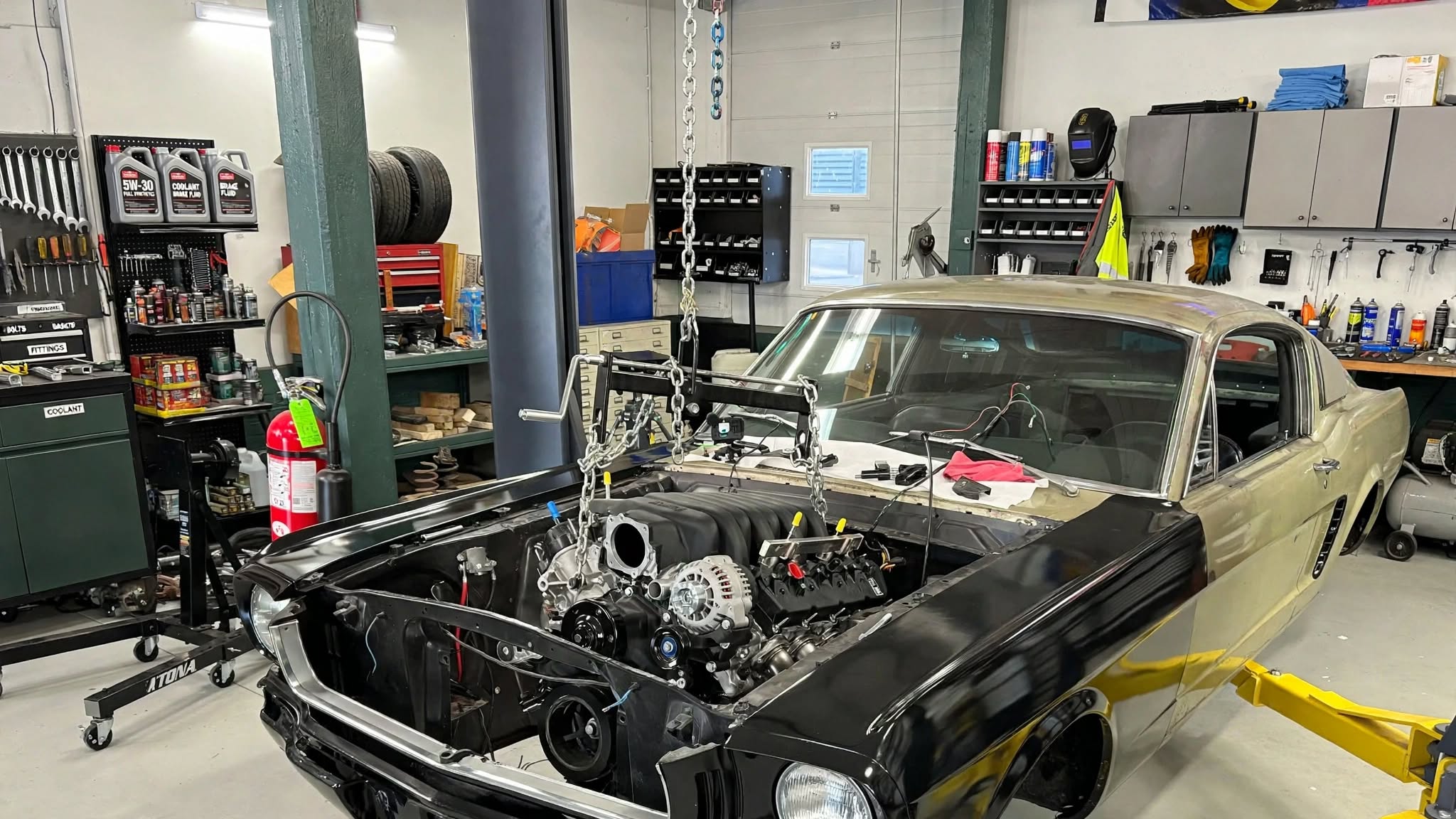
Swap Tech Guide
1964–70 Mustang Godzilla Swap Tech Guide
Godzilla Performance Engines · Proformance Unlimited · Updated Oct 17, 2026
A 7.3L Godzilla will go into a 1964½–1970 Mustang, but not as a bolt-in: plan on shock tower work, a low-profile intake and pan, swap headers and swap mounts before the engine ever drops in. Done right, you get 445 cubic inches of modern, fuel-injected Ford pushrod V8 in the car it looks like it was always meant for.
At a Glance
Why the Godzilla Fits a Classic Mustang
Ford built the 7.3L Godzilla crate engine for Super Duty trucks, but it has quickly become one of the best Ford swap engines going. Stock it makes 430 hp and 475 lb-ft, and a cam, intake and headers push it toward 600 hp at the crank. It is a cam-in-block engine with a forged crank and cross-bolted mains, so it is simple, tough and easy to package compared with a four-cam modular engine.
This guide covers first-generation Mustangs from 1964½ through 1970: shock towers, front suspension and A-arms, motor mounts, headers, automatic and manual transmissions, EFI fuel tanks and cooling, then a parts checklist.
Section 1
Before You Start: Size, Weight & Planning
The Godzilla is about 2 inches taller and wider than a 351 Windsor, so the shock towers and the hood line are where a first-gen Mustang fights back. The fix is to make the engine smaller where it counts and the engine bay bigger where it has to be.
| Measurement | 7.3L Godzilla |
|---|---|
| Width at valve covers | About 25.5 in. |
| Length | About 24 in. |
| Height, intake to pan (stock intake and pan) | 32-1/8 in. |
| Height with Holley low-profile intake and Holley pan | 28-1/4 in. (3-7/8 in. lower) |
| Dressed weight | About 540 lb |
| Bellhousing pattern | Same as 4.6/5.0 Coyote |
- Which years are easier? The 1967–1970 cars have the wider engine bay Ford created for the FE big-blocks, so they give you more room at the towers. The 1964½–1966 cars are narrower and almost always need more aggressive shock tower work or a full tower-delete front end.
- Pick your parts as a system. Mounts, headers, oil pan, K-member and steering all have to agree with each other. Most swap headers are designed around one specific K-member and mount, so choose the front suspension first and buy the headers and mounts that were built for it.
Start with a swap-ready engine. The truck oil pan is deep and the truck intake points the throttle body up toward the hood. Nearly every Godzilla swap uses an aftermarket rear-sump pan and a forward-facing intake. Most of our Godzilla Performance Engines packages ship with the Holley oil pan and front accessory drive already installed.
Section 2
Shock Tower Modifications
The shock towers are the single biggest obstacle in a first-gen Mustang Godzilla swap, because the Godzilla’s wide heads and exhaust ports land right where the towers are. You have three ways to deal with them, from least to most invasive.
| Approach | What It Involves | Best For |
|---|---|---|
| Notch and reinforce | Cut and re-plate the inner face of each tower for header room; keep the factory-style front end | Budget builds, mostly 1967–70 cars, owners who want the towers to look stock from above |
| Tubular K-member with notched towers | Bolt-in tubular K-member, coilovers, tubular lower arms and late-model spindles; towers notched on the sides | The most proven Godzilla route today, with swap mounts and headers already built for it |
| Full tower delete | Towers cut out and closed off with panels; a complete aftermarket front subframe or chassis carries the suspension | Pro-touring and high-dollar builds, 1964½–66 cars, maximum header and spark plug access |
Option 1: Notch and Reinforce
The inner wall of each tower is cut back where the header tubes pass, then rebuilt with a flatter, boxed plate welded in. This is real fabrication work, and the towers carry the upper control arm and spring loads, so it should be done by someone who welds structural steel. Always add bracing afterward: an export brace and a Monte Carlo bar tie the towers to the cowl and to each other. Total Control Products sells an adjustable aluminum brace set for 1965–70 cars.
Option 2: Tubular K-Member (AJE)
AJE Suspension’s tubular K-member bolts in after you cut off the original motor mount and lower control arm mounts. It uses a Fox-body rack-and-pinion and Fox or SN95 spindles, and AJE recommends notching the sides of the towers for big engines. It also requires a rear-sump oil pan, which matches the Holley pan most Godzilla packages already use. AJE makes dedicated 7.3L Godzilla motor mounts for this K-member, and Ultimate Headers builds early-Mustang Godzilla headers around it. AJE also offers an export brace and Monte Carlo bar kit for its front end.
Option 3: Full Shock Tower Delete
Removing the towers entirely gives the most room for headers, plugs and steering. The suspension then has to come from a complete aftermarket front end, such as the Detroit Speed Aluma-Frame, the Total Control Products front frame clip, or a full chassis like the Roadster Shop SPEC used in Modern Rodding’s 1965 Godzilla fastback. Detroit Speed’s delete kit closes off the inner fenders with 14-gauge panels that can be welded or bolted in.
Before you buy a tower-delete system: most were developed around the Coyote and LS. Confirm Godzilla engine fitment, mount availability and header fitment with the suspension maker. Detroit Speed, for example, notes the Aluma-Frame needs modification to clear the alternator on modular Ford engines.
Section 3
A-Arm & Front Suspension Modifications
If you keep the factory-style front end, a Shelby drop on the upper A-arms plus coilovers sized for big-block weight is the baseline. If you go to a K-member or tower-delete system, the arms come with it and you should not modify them.
Upper A-Arms: The Shelby Drop
The classic Shelby drop lowers the upper control arm pivot by 1 inch on the shock tower. It improves camber gain in a turn and moves the arm’s inner end down, away from where the header tubes want to run. Shelby limited the street cars to 1 inch because larger drops caused ball joint problems.
- Drill-and-relocate: new holes are drilled 1 inch below the stock ones using a template. Cheap, but you are drilling into the towers you may also be notching, so plan both jobs together.
- Drop-built upper arms: Total Control Products and others sell upper arms with the 1-inch drop built into the cross shaft, so you get the geometry without new holes.
- Tubular upper arms: go with tubular arms when the towers are notched. They are lighter, stronger and usually give more clearance than stamped arms.
Springs, Shocks & Coilovers
A dressed Godzilla weighs about 540 lb, so springs rated for a small-block will sit low and bottom out. Use big-block rates. Total Control Products’ bolt-on coilover kit for 1967–73 is offered with big-block springs and replaces the factory upper shock mount and lower spring perch. Taking the coil spring out of the tower also frees up room around the tower.
Lower Arms, Spindles & Brakes
The AJE system uses its own tubular lower arms with late-model Mustang spindles, which opens up modern brake options. With a factory-style front end, add a strut rod upgrade and a bump steer kit if you lower the car.
Steering
The steering shaft is one of the tightest spots in the swap. In Modern Rodding’s 1965 fastback, the steering shaft runs into the driver-side header and had to be addressed. A rack-and-pinion conversion, such as TCP’s big-block power rack or the Fox rack used by the AJE K-member, clears the box and drag link out of the way. Check the oil pan to rack clearance before final mounting.
Section 4
Motor Mounts & Engine Placement
Use mounts made for the Godzilla and matched to your front suspension, because the mounts decide where the engine sits, and that decides whether the headers, oil pan, steering and hood all clear.
| Mount Option | Fits | Notes |
|---|---|---|
| AJE 7.3L Godzilla motor mounts (AJE-7.3) | AJE tubular K-member only | Bolt-in, USA-made; pairs with Ultimate Headers’ AJE/MTF long tubes |
| G Force DIY Godzilla engine mount kit | Any chassis, weld-in | Laser-cut 1/4-in. steel plates, poly bushings and hardware; you build the frame-side mounts |
| Mounts supplied with a tower-delete subframe or chassis | That system only | Ask the maker for Godzilla-specific mounts before ordering |
- Setting engine position. Mock up with the engine dressed the way it will run: intake, accessory drive, oil pan and headers all on. A mock-up block is a big help if you plan to fabricate. Set the engine as low as the oil pan and crossmember allow, centered side to side, and check the crank centerline against the pinion for driveline angle (most builders aim for about 2–3 degrees down at the transmission tailshaft, matched at the pinion).
- Clearance checks before you weld or drill. Header tubes to towers and steering shaft, oil pan to crossmember or K-member and rack, intake and throttle body to hood, front pulleys to radiator and fan, and bellhousing to firewall and tunnel.
Section 5
Headers & Exhaust
Use Godzilla-specific swap headers built for your front suspension. Small-block Ford headers will not bolt to the Godzilla’s tall, straight exhaust ports, and generic big-block headers will not clear the towers.
| Header | Style | Fits | Notes |
|---|---|---|---|
| Ultimate Headers 432031 | Long tube, stainless | 1964½–73 Mustang with AJE or MTF K-member | Cast stainless flanges and tight-radius elbows; Cometic gaskets and bolts included |
| Ultimate Headers 432051 | Mid-length, 1-7/8 in. primaries, stainless | 1967–73 Mustang and F-100 swaps | Shorter tubes for tighter bays; 3 in. slip-fit collectors |
| Custom-built | Any | Tower-delete and full-chassis builds | The usual route when the chassis maker does not list a Godzilla header |
Our recommendation: if you run the AJE (or MTF) K-member, the Ultimate Headers 432031 Early Mustang long tubes are the header we suggest. They were designed around that K-member and the matching Godzilla mounts, and we stock them at Proformance Unlimited for $1,875.
Tips for a clean fit:
- Buy the headers that match your K-member and mounts. Header makers design around one specific engine position, so a different mount can put a tube into a tower or the steering shaft.
- Watch the driver side. The steering shaft and the header share the same space; plan for a rack-and-pinion or a rerouted shaft with extra U-joints.
- Plan the mid-pipe. Swap headers typically end in 3 in. slip-fit collectors, and you will usually need a custom or semi-custom mid-pipe with an X- or H-pipe to reach the rest of the exhaust.
- Put the O2 sensor bungs where the EFI system wants them, upstream of any crossover.
- Wrap or coat near the starter, the master cylinder and the clutch hydraulics.
Most long-tube swap headers are sold for off-road or racing use only, so check your state’s emissions rules before you build a street car around them.
Section 6
Transmission Options: Automatic & Manual
The Godzilla uses the same bellhousing bolt pattern as the 4.6/5.0 modular and Coyote engines, and the same 8-bolt crank flange as the Coyote, so most transmissions already built for Coyote swaps will bolt up. For most first-gen Mustangs, that means a Tremec TKX for a stick or a 6R80/10R80 for an automatic.
Manual Transmissions
| Transmission | Why Choose It | What to Plan For |
|---|---|---|
| Tremec TKX 5-speed | Compact case, rated for 600 lb-ft; complete classic-Mustang kits exist | Coyote-pattern bellhousing, clutch and flywheel for the 8-bolt crank, crossmember, hydraulic clutch |
| Tremec T56 Magnum 6-speed | Higher torque capacity and a second overdrive | Larger case; plan on tunnel work and a custom crossmember |
The TKX is the go-to choice. Silver Sport Transmissions sells complete TKX kits for 1964–66 and 1967–70 Mustangs. Modern Rodding’s 1965 Godzilla fastback uses an SST kit with a McLeod clutch, hydraulic throwout bearing and Quick Time SFI bellhousing, and Tremec’s own 1965 Godzilla build also runs a TKX.
Things to know with a stick:
- A car that was originally automatic needs a clutch pedal assembly.
- Use a hydraulic clutch. Swap headers leave little room for a mechanical Z-bar linkage.
- The 1964½–66 tunnel is smaller. Depending on the kit, getting a correct driveline angle can mean raising the tunnel at the front of the transmission.
- A stock Godzilla makes 475 lb-ft. If your build is well above that, look past the TKX.
Automatic Transmissions
| Transmission | Why Choose It | What to Plan For |
|---|---|---|
| Ford 10R80 10-speed | Modern factory pairing for big Ford V8s; great gearing and drivability | Large case; tunnel work in most first-gens; needs a transmission controller |
| Ford 6R80 6-speed | Proven behind the Coyote; a bit easier to package than the 10R80 | Needs a transmission controller; check tunnel clearance |
| Ford 4R70W/4R75W 4-speed | Shares the bolt pattern; compact and inexpensive | Older design and lower power capacity; needs electronic control |
| GM 4L80E with adapter kit | Very strong; common in high-horsepower builds | Adapter bellhousing and a flexplate that matches the Godzilla’s 8-bolt crank |
Every one of these is electronically controlled, so choose the transmission and the engine management together. Our Ford Performance control pack for the 10R80 runs the engine and transmission as a matched set (it requires the Ford Performance intake). Whatever you choose, plan on a new crossmember, a custom driveshaft, a transmission cooler, and a shifter that fits your console.
Section 7
EFI Fuel Tank & Fuel System Options
The Godzilla is port fuel injected, so the carbureted-era tank and mechanical pump have to go; an in-tank EFI pump in a baffled tank is the right answer for a street car. Size the pump to the engine’s power, not its stock rating, since a built Godzilla can pass 550 hp quickly.
| Option | Fits | Pump / Rating | Notes |
|---|---|---|---|
| Holley Sniper in-tank pump module (12-305) | Factory 1964½–70 tanks (16, 20 and 22 gal.) | 255 LPH, up to 550 hp; regulated to 58 psi | Drops into the stock tank, returnless, includes HydraMat; can reuse the factory hard line with EFI-rated hose |
| Holley Sniper EFI tank kit (19-417) | 1969–70 | 400 LPH | 22-gal. baffled tank with a 4.3-liter internal tray; lines and filler neck not included |
| Aeromotive Gen II Stealth tank | 1969–70 | 340 LPH | Stock-looking stamped tank; pump, sender and bulkhead pre-installed |
| FiTech Go Fuel tank kit | 1969–70 | 340 LPH or higher | Rated for 800 or 1,000 hp depending on pump; AN-6 ports |
Our picks. For a mild, naturally aspirated Godzilla up to about 550 hp, the Holley drop-in module is the simplest route and keeps the factory tank. For a built engine, a 1969–70 car, or anything with boost, go to a complete baffled EFI tank with a 340–400 LPH pump.
Lines, filter and wiring. Run EFI-rated supply line, at least 3/8 in. (AN-6), with a quality 10-micron filter. If your system uses a return, add a return line and a regulator set to the pressure your engine management calls for. Power the pump through a relay with heavy-gauge wire, because a starving pump feels exactly like a bad tune.
Section 8
Radiator & Electric Fan Options
Our first choice for cooling a Godzilla-swapped first-gen Mustang is a Be Cool factory-fit module: an aluminum radiator, shrouded electric fans, brackets, wiring, cap and overflow tank in one box, sized to drop into the stock core support. A 445-cubic-inch engine makes a lot of heat, and a mechanical fan will not fit well in front of the Holley accessory drive anyway.
Be Cool’s factory-fit modules use two rows of 1 in. tubes and are rated to cool up to 1,000 hp depending on the application. Kits typically include the radiator, electric fans with brackets, a Be Cool cap, an overflow can and a fan wiring kit.
| Be Cool Part | Fits | What It Is |
|---|---|---|
| 82238 / 82159 | 1964½–66 Mustang | Factory Fit Modules (radiator + fans + wiring) |
| 83238 / 80238 | 1964½–66 Mustang | Show & Go Modules |
| 82187 | 1967–70 Mustang | Factory Fit Module |
| 60187 / 62263 | 1967–70 Mustang | Radiator only: 60187 for manual trans, 62263 for automatic (with trans cooler) |
Confirm the exact part number with Be Cool for your year, transmission and hose locations before ordering; the 1964½–66 cars have a much smaller core support than the 1967–70 cars.
Making it work with the Godzilla:
- Hose routing. The Godzilla’s water pump outlets do not line up with a 289/302’s, so plan on custom or flexible hoses, especially with the Holley accessory drive.
- Fill and bleed. Put the fill point at the highest point in the system. Many swaps add a remote fill neck or surge tank so air can’t get trapped in the heads.
- Fan control. Let the engine management switch the fans through relays (low and high speed if you have two). It’s more precise than a standalone thermostat switch.
- Automatic and A/C. An automatic needs a cooler, either in the radiator tank or a separate stacked cooler. With A/C, leave room for the condenser ahead of the radiator.
- Seal the air path. Close the gaps around the radiator so air has to go through the core, not around it.
Section 9
Other Details That Make or Break the Swap
- Intake and hood clearance. The truck intake points the throttle body up, which is a hood problem. A forward-facing intake fixes it. Holley’s low-profile Godzilla intake drops height by 2 to 3-1/2 inches and let Modern Rodding keep the stock hood on its 1965 fastback. Tall or long-runner intakes may need a cowl hood.
- Oil pan. The factory pan is deep and front-heavy. The Holley rear-sump pan measures 6-1/4 in. from the rail versus 8-1/8 in. stock, and it is the pan the AJE K-member calls for.
- Accessory drive. The truck accessory drive is too wide for a Mustang. A compact swap drive such as the Holley kit (alternator, power steering and A/C options) packages tighter and clears the chassis.
- Engine management and wiring. The Godzilla needs a standalone engine management system: Holley Terminator X Max, OBR, or Ford Performance’s control pack. Plan the harness routing, the drive-by-wire pedal mount, and where the ECU lives before the interior goes back in.
- Brakes. Check the brake booster and master cylinder against the driver-side valve cover and header. A smaller booster or a manual master cylinder is a common fix. With roughly 500-plus horsepower, upgrade to front disc brakes at minimum.
- Rear axle and chassis. Many builders step up to a Ford 9-inch with a stronger housing and axles; Tremec’s 1965 Godzilla Mustang and a 1967 Godzilla Mustang sold at Mecum both run Currie 9-inch rears. Subframe connectors are cheap insurance against chassis flex.
Section 10
Parts Checklist
- Swap-ready 7.3L Godzilla with rear-sump pan, compact accessory drive and forward-facing intake
- Front suspension plan: notched towers, tubular K-member, or tower-delete subframe
- Upper A-arms (Shelby drop or drop-built) or the arms supplied with your K-member
- Big-block-rate springs or coilovers
- Shock tower bracing: export brace and Monte Carlo bar
- Rack-and-pinion steering and steering shaft routed clear of the header
- Godzilla motor mounts matched to the K-member
- Godzilla swap headers matched to the K-member and mounts, plus mid-pipe
- Transmission, Coyote-pattern bellhousing or adapter, clutch/flywheel or flexplate, crossmember, driveshaft
- Engine management, harness, DBW pedal and transmission controller
- EFI fuel tank or in-tank module, EFI-rated lines, filter, relay wiring
- Be Cool radiator module with electric fans, hoses and fill/bleed point
- Brake booster/master cylinder clearance and front disc brakes
- Rear axle and subframe connectors
Mustang Godzilla Swap FAQ
Will a 7.3 Godzilla fit in a 1964½–1970 Mustang?
Yes, but it is not a bolt-in. Plan on shock tower work, Godzilla swap mounts, swap headers, a rear-sump oil pan and a low-profile intake. The 1967–70 cars have a wider engine bay and are easier; the 1964½–66 cars usually need more aggressive tower work or a full tower-delete front end.
Do I have to cut the shock towers for a Godzilla swap?
In almost every first-gen Mustang, yes. The options are notching and reinforcing the towers, running a tubular K-member such as AJE with the tower sides notched, or removing the towers completely with an aftermarket front subframe or chassis.
What headers fit a Godzilla-swapped classic Mustang?
For cars with an AJE or MTF K-member, we recommend the Ultimate Headers 432031 Early Mustang long tubes. Ultimate Headers also makes the 432051 mid-length header for 1967–73 Mustangs. Tower-delete and full-chassis cars usually need custom headers.
What transmissions bolt to the 7.3L Godzilla?
The Godzilla shares the 4.6/5.0 modular and Coyote bellhousing pattern and the Coyote 8-bolt crank flange. Common choices are the Tremec TKX or T56 Magnum for a manual and the Ford 10R80, 6R80 or 4R70W for an automatic. A GM 4L80E works with an adapter kit.
Can I keep the stock hood on a Godzilla-swapped Mustang?
Often, yes. With the Holley low-profile intake and Holley rear-sump pan, Modern Rodding kept the stock hood on its 1965 Godzilla fastback. Taller or long-runner intakes may need a cowl hood.
What fuel pump does a Godzilla swap need?
A drop-in 255 LPH in-tank module such as the Holley Sniper 12-305 supports up to about 550 hp in the stock 1964½–70 tank. Built or boosted engines should use a baffled EFI tank with a 340–400 LPH pump.
What radiator should I use for a Godzilla swap in a classic Mustang?
We like a Be Cool factory-fit aluminum radiator module with electric fans. It drops into the stock core support and includes the fans, wiring, cap and overflow tank. Confirm the part number for your year and transmission with Be Cool.
Start With the Right Engine
The easiest Godzilla swap starts with an engine that is already dressed for a classic car. Godzilla Performance Engines builds 7.3L Godzillas with the oiling system, accessory drive, intake, engine management and finishing touches you choose, and every package is assembled by Proformance Unlimited in Melbourne, Florida. Tell us your year, suspension plan and transmission and we’ll confirm fitment.
Sources
- 7.3 Godzilla V8 Fitted in a 1965 Ford Mustang — In The Garage Media / Modern Rodding
- Godzilla Swap – Retrofitting a 7.3 engine into a 1965 Mustang — In The Garage Media
- AJE Suspension tubular K-member, 1965–70 Mustang — CJ Pony Parts
- AJE 7.3L Godzilla motor mounts — CJ Pony Parts
- Detroit Speed shock tower delete instructions
- Total Control Products big-block coilover kit — CJ Pony Parts
- Silver Sport Transmissions TKX kit, 1964–66 Mustang
- Be Cool Mustang radiators and modules — Summit Racing
- 1965 Mustang with a 7.3L Godzilla V8 — Engine Swap Depot